Amsterdam New Cinema Film Festival


MILO
a Short Film by Venkatesh Bala
Congratulations on winning the Best Animation Short Film award at the May Monthly Competition of the Amsterdam New Cinema Film Festival. What does this recognition mean to you and to MILO?
It honestly means a lot. MILO began as a very small and personal experiment, created with limited resources but a lot of belief in the story. So, seeing it connect with a jury in Amsterdam feels incredibly validating. For me, the award is also proof that an emotional story does not need a massive budget or a huge production team. It just needs an idea people can feel. MILO may be tiny, quite literally, but this recognition gives his story a much bigger voice.
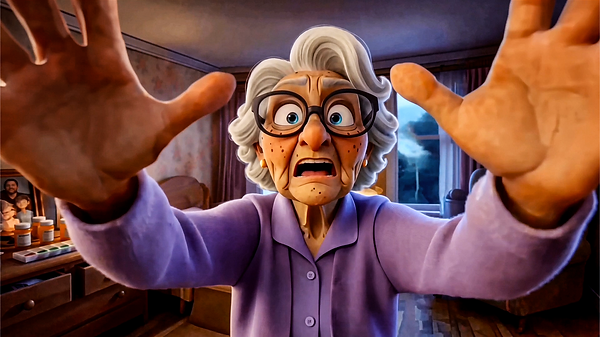
MILO tells the story of a nervous young mosquito who has one final chance to pass his singing exam by performing a perfect lullaby into a human's ear without getting swatted. How did the idea for this unique and original story first come to you?
The idea actually came from something my wife casually said during a trip. A mosquito was buzzing near her ear, and she said, “The mosquitoes are singing in my ears.” That sentence immediately changed the way I saw the situation. Instead of imagining an irritating mosquito, I suddenly imagined a tiny performer trying his best to sing to an audience that absolutely did not want him there. From there, the idea became a singing exam. Milo was no longer simply
buzzing. He was a nervous student with one final chance to prove himself. The more I developed it, the more I realised that beneath the comedy, there was space for something much more emotional.
At the heart of the film is an unexpected bond between a young mosquito and a lonely grandmother, brought together by a lullaby that carries deep emotional meaning. What inspired you to explore themes of grief, memory, and human connection through such unconventional characters?
I loved the idea of bringing together two characters who, on the surface, should never connect. Milo enters the room because he needs to pass his exam. The grandmother listens because the melody reminds her of her late husband. Both characters need something from that moment, but for completely different reasons. I also wanted to explore how memories can be triggered by the smallest things. Sometimes it is not a photograph or a major event. It can be a sound, a smell, or
a few notes of an old song. In this case, the smallest possible voice awakens one of her biggest memories. That contrast felt very powerful to me. The lullaby becomes much more than a test. It carries love, memories, and ultimately hope.
What does this melody symbolize for you, and why did you choose music as the emotional core of the story?
The lullaby represents a connection that time and loss have not completely erased. For Milo, it begins as something technical. He needs to perform every note correctly to pass. But for the grandmother, those same notes hold an entire lifetime of love. As the story progresses, the song stops belonging to Milo alone. When she begins humming the missing part, it becomes something they complete together. Music was perfect for the story because it can communicate emotion without explanation. I did not want the grandmother to tell the audience what she was feeling. I wanted the audience to feel it with her the moment she recognised the melody.
You describe yourself as an Advertising Senior Creative, obsessed with finding new ways of storytelling through AI. How has your background in advertising and your experimentation with AI shaped your approach to filmmaking?
Advertising teaches you to communicate quickly. You are constantly asking yourself: What is the strongest visual? What is the simplest way to express the idea? How do you make someone care within the first few seconds? That thinking definitely shaped MILO. The film is less than seven minutes, so every expression, sound and shot has to move the story forward. AI gave me the freedom to explore the world visually without waiting for a traditional production setup. I could test character designs, environments, lighting and camera ideas very quickly. But AI was never the storyteller. The emotions, performances, pacing and decisions still had to come from me.
I see AI as a new kind of creative collaborator. It can give you possibilities, but you still need a clear point of view. Otherwise, it is just beautifully generated noise.
In less than seven minutes, MILO takes the audience from humor and suspense to a deeply emotional ending. What were the biggest challenges in balancing these different tones within such a short runtime?
That was probably the hardest part of making the film. The beginning needed to feel playful and slightly ridiculous. Milo is a mosquito attending an academy, carrying the pressure of repeated failures and preparing to perform inside a human ear. The situation is naturally funny. But I did not want the emotional shift to feel like it belonged to a completely different film. So, instead of suddenly forcing sadness into the story, I allowed the grandmother’s reaction to slowly change the mood. The suspense also helped connect the tones. Her hand is always close to swatting him, so even during the emotional moments, the danger never completely disappears.
The ending was built around the idea that triumph and tragedy could exist in the same moment. Throughout the film, the audience expects Milo to be swatted, so his greatest success also carries the possibility of becoming his final performance. The goal was to make the audience laugh at Milo first, worry about him next, and finally care about both characters.
The film relies heavily on visual storytelling, expressive animation, and carefully crafted sound design. How did you approach the relationship between animation, music, and audio to create such a strong emotional impact?
Sound is almost another character in MILO. Because Milo is a mosquito and the story revolves around singing, the audio needed to carry both the comedy and the emotion. His tiny voice, nervous breathing, wing movements and the threatening sound of the grandmother’s hand all help us experience the moment from his perspective. Visually, I tried to keep the performances subtle. A small pause, a trembling movement or a change in the grandmother’s eyes could say more than
dialogue. The music also had to evolve naturally. It begins as Milo’s exam piece, but slowly transforms into the grandmother’s memory. By the time she joins the melody, the animation, music and emotion are all telling the same story.
MILO was produced on a remarkably modest budget of around $500, yet it has a polished, cinematic quality. Could you share some of the creative solutions, AI tools, or production techniques that helped you achieve this result?
The biggest solution was being extremely selective. I could not approach the film like a large animation studio, so I treated every shot as something that had to earn its place. I planned the film carefully, created it sequence by sequence and avoided generating unnecessary material. AI helped with character exploration, visual development, environments and motion testing. I experimented across different image and video generation tools, then used more traditional editing, compositing, colour correction and sound design to bring everything together. Consistency was one of the biggest challenges. AI can create a beautiful shot very quickly, but making the next shot feel like it belongs in the same film takes a lot of patience. There were many generations, adjustments and tiny fixes behind every usable moment. The budget may have been less than $500, but the real investment was time, obsession and a slightly unhealthy relationship with the replay button.
As the writer, director, and producer of MILO, how do you balance these different creative roles while staying faithful to your original vision?
The advantage is that I always knew what the heart of the film was. Every decision could be measured against one question: Does this make the audience care more about Milo and the grandmother? As a writer, I focused on the emotional journey. As a director, I concentrated on performance, framing and rhythm. As a producer, I had to be practical and find ways to achieve the idea within the limitations. Of course, these roles sometimes fight with each other. The director wants another beautiful shot, while the producer says, “We have enough shots, please move on.” But having one clear emotional objective helped keep everything aligned.
Looking ahead, do you plan to continue exploring AI-assisted filmmaking and animation? What kinds of stories are you most excited to tell in the future?
Absolutely. MILO made me realise how much is now possible for independent creators. I want to continue exploring stories that begin with unusual or humorous ideas but reveal something deeply human underneath. I am especially interested in characters we normally ignore, misunderstand or never imagine as protagonists. AI allows filmmakers to visualise worlds that may once have been impossible without major resources. But the technology itself is not what excites me most. What excites me is the opportunity to tell stories that might otherwise never be made. For me, the future is not about replacing traditional filmmaking. It is about giving more people the ability to turn imagination into cinema. And hopefully, to help a few more tiny voices get heard.